

As the world continues to grapple with environmental challenges and the need for sustainable solutions becomes more pressing than ever, the catalytic convertor value in the automotive industry has risen dramatically. These unassuming devices, tucked away in a car's exhaust system, symbolize the shift towards a greener economy and underscore the growing emphasis on sustainability.
Catalytic converters are vital components in modern vehicles, tasked with transforming harmful emissions into less harmful substances before they are released into the atmosphere. Their ability to convert nitrogen oxides (NOx), carbon monoxide (CO), and hydrocarbons (HC) into nitrogen, carbon dioxide (CO2), and water vapor, respectively, significantly reduces the adverse impact of vehicular emissions on the environment. Catalyst convertor can catalyze the oxidation-reduction reaction of carbon monoxide, nitrogen-hydrogen compounds and nitrogen-oxygen compounds in the automobile exhaust, reducing automobile exhaust pollution, which is an essential part of the automotive industry. Because the three-way catalyst contains platinum (Pt), palladium (Pd), rhodium (Rh) and other rare and precious metals, these metals can be recycled and reused and are conducive to environmental protection, so the recycling of the three-way catalyst and the identification of true and false need to be fast and effective analysis and detection methods. And Terra900 can play an important role in testing these precious metal elements of Pt,Pd,Rh.
With Terra900 Handheld XRF spectrometers, it takes just seconds to give the result comparing with hours or days as in a laboratory. Together with simple operation training and easy sample preparation, they are ideal and affordable solution for the daily business for quality control and price evaluation during catalyst’s dealing.
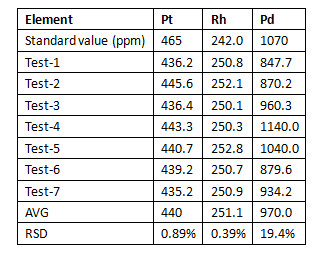
Following is the testing data for a catalyst standard to verify the testing stability of handheld XRF analyzer with a catalyst calibration.
The principle behind catalytic converters is simple yet impactful. They house a catalyst composed of precious metals like platinum, palladium, and rhodium, which facilitate chemical reactions that convert toxic gases into benign compounds. This transformation exemplifies the potential for technology to mitigate the consequences of human activities on the natural world.

The increased value of catalytic converters mirrors a broader trend toward sustainability and the green economy. As governments, industries, and consumers prioritize environmental stewardship, the demand for cleaner transportation options and reduced carbon footprints has intensified. This shift has driven significant advancements in automotive technology, with catalytic converters playing a pivotal role.
The rise of electric and hybrid vehicles has often garnered attention in discussions about sustainability, yet the existing fleet of internal combustion engine (ICE) vehicles cannot be overlooked. By retrofitting older vehicles with advanced catalytic converters or ensuring the optimal functioning of these devices, society can extend the lifespan of ICE vehicles while minimizing their environmental impact.
While catalytic converters are undeniably crucial for emission reduction, their reliance on precious metals has presented both challenges and opportunities. The increasing demand for these metals, particularly palladium and rhodium, has led to concerns about supply chain sustainability and ethical mining practices. The industry's response to these challenges will further define its alignment with the principles of the green economy.
Opportunities also abound. Research into new catalyst materials, such as non-precious metal alternatives, holds promise for reducing the reliance on scarce resources. Moreover, advances in catalytic converter technology, such as improved efficiency and durability, can enhance their overall environmental impact and longevity.

Catalytic converters are more than mechanical components; they represent a tangible link between sustainable aspirations and practical implementation. Their value surge is indicative of a broader acknowledgment that environmental stewardship and economic growth are not mutually exclusive. Instead, they can reinforce each other, driving innovation, job creation, and societal progress.
As governments enforce stricter emissions regulations and consumers become more conscious of their ecological footprint, catalytic converters will continue to play a pivotal role in the automotive industry's evolution. This transformation reflects not only a technological shift but also a societal commitment to leaving a healthier planet for future generations.
In the journey towards a greener economy, catalytic converters serve as a beacon of hope, reminding us that with ingenuity and determination, we can convert challenges into opportunities and drive positive change for the world we share.
 Your location:
