

Driven by modern technology, more and more industries are relying on spectral analysis instruments to solve various problems. From agriculture to healthcare, from food safety to environmental monitoring, spectral instruments have become indispensable tools for scientific research and industrial applications. However, with the continuous expansion of the market, finding the most cost-effective handheld spectroscopic instruments has become increasingly complex. Finding a balance between price and performance is a challenge for buyers. In this article, we will explore how to find the most favorable transaction in the handheld spectrometer price market and balance the relationship between price and performance. You need to do the following: understand your needs, understand the market, balance prices and performance. Firstly, in order to find the most suitable handheld spectroscopic instrument for you, you need to clarify your own needs. Different applications require different types of spectral instruments. If you need to perform basic color analysis or quality control testing, low-cost spectroscopic instruments may be sufficient. However, if you are engaged in highly precise scientific research or require precise analysis, you may need to consider more expensive but powerful instruments. Once you have identified your needs, the next step is to understand the options for handheld spectrometers on the market. There are various brands and models to choose from in the market now, each with its own characteristics and advantages. By reviewing online reviews, consulting with peers, and communicating with suppliers, you can better understand the performance and reliability of different instruments. The balance between price and performance is crucial when purchasing handheld spectroscopic instruments. Considering budget and performance requirements, you can choose the instrument with the highest cost-effectiveness. Please remember that not only does it depend on the price, but also on the long-term cost of using the instrument, such as maintenance and calibration.
Here are some suggestions to help you find the best deals in the handheld spectrometer market. Firstly, compare different brands and models, and do not rush to purchase the first spectroscopic instrument you see. Compare different brands and models to ensure that you receive the instrument that best suits your needs. Alternatively, you can consult experts. If you are unsure which spectral instrument is most suitable for your application, consulting experts or peers can provide useful advice. At the same time, you need to consider performance and reliability. In addition to price, you also need to consider the performance and reliability of the instrument. Low quality instruments may cause more trouble in long-term use.

The XRF (X-ray fluorescence) chemical element handheld spectrometer is a portable instrument used for analyzing the elemental composition of substances. It determines the presence and content of different elements by measuring X-ray induced fluorescence in the sample. These instruments are widely used in multiple fields, including metal and alloy analysis, geology, environmental monitoring, building material testing, archaeology, and art appraisal.
The following are some key features and working principles of the XRF handheld spectrometer:
Non destructive analysis: One of the main advantages of XRF handheld spectrometers is that they can perform elemental analysis without damaging the sample. This is very important for precious cultural relics, engineering materials, or any samples that require integrity.
Rapid analysis: These instruments typically provide accurate elemental analysis results within seconds, making them highly suitable for on-site applications that require rapid decision-making, such as metal alloy classification or quality control.
Widely used: XRF handheld spectrometers can be used to analyze various elements from light metals such as magnesium and aluminum to heavy metals such as lead and uranium. This makes them very useful in multiple industries.
Portability: These instruments typically have a lightweight design that is easy to carry and use, and are suitable for analysis outside the laboratory, in the field, or on-site.
User friendly: Most XRF handheld spectrometers are equipped with an intuitive user interface, making operation simple and easy to understand. They can also store and transmit data for subsequent analysis and reporting.
Sample preparation is simple: Unlike many traditional chemical analysis methods, XRF does not require complex sample preparation. Usually, you only need to place the sample in front of the instrument, press the button, and then proceed with the analysis.
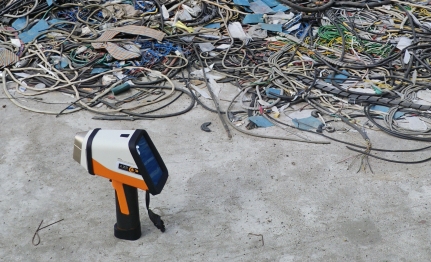
The working principle of an XRF handheld spectrometer is to use X-rays or gamma rays to excite atomic nuclei in the sample. After excitation, the atomic nuclei in the sample will emit X-ray fluorescence of specific energy, and the energy and intensity of these X-ray fluorescence are related to the type and content of elements in the sample. The instrument determines the presence and concentration of elements by measuring the energy spectrum of these X-ray fluorescence. The X-ray fluorescence spectra of different elements are unique and can be used for quantitative and qualitative analysis.
AXR offers a range of products, including the Terra series handheld X-ray fluorescence (XRF) spectrometers, handheld XRF spectrometers, online XRF analyzers, XRF tabletop gold analyzers, XRF spectrum integrated modules, and more. The Terra series handheld alloy analyzers, such as the Terra 900, have become indispensable tools for quality control, alloy identification, material classification, safety precautions, and more. These instruments provide rapid metal composition analysis within seconds and display alloy grades and element content on a touchscreen. With minimal training, users can proficiently operate the instrument, making sample testing location-independent and eliminating the need for sample preparation.
So, how do you choose the most suitable portable XRF instrument for your needs? Selecting the right portable XRF instrument involves considering multiple factors, including the application area, range of elements, performance requirements, sample types, portability, analysis speed, data processing and software, budget, support and training, safety standards, user feedback, and upgradability, among others. Based on these criteria, it is highly recommended to consider the various series of handheld analyzers from the AXR brand. This brand offers a wide range of applications, nearly covering all the application areas mentioned earlier. It can detect a range of elements, including Ti, V, Cr, Mn, Fe, Co, Ni, Hf, Ta, Re, Cu, Zn, W, Se, Pb, Bi, Zr, Nb, Mo, Al, Pd, Ag, Sn, Sb, and more, depending on the mode. The detectors used are High-performance Si-Pin detectors or Optimized SDD detectors. These instruments are suitable for a wide variety of sample types, are compact and lightweight, highly portable, provide fast analysis (typically 15 to 30 seconds per test), have reasonable software update frequencies, offer excellent value for money, and provide product training and regular updates. User feedback rates are above 95%, making it one of the most popular brands in its category.
Finding the best deal in the handheld spectrometer market is not easy, but by carefully considering your needs, understanding the market, and balancing price and performance, you can find the instrument that is most suitable for you. Whether you are engaged in scientific research or industrial applications, a cost-effective handheld spectroscopic instrument can improve your work efficiency and accuracy, bringing greater success to your project.
 Your location:
