

For anyone in industries like mining, manufacturing, scrap recycling, or environmental testing, X-ray Fluorescence (XRF) has become an indispensable tool for rapid, non-destructive elemental analysis. But when it comes time to invest in an XRF analyzer, a fundamental question arises: should you choose a portable/handheld unit or a benchtop laboratory system?
This isn't just a matter of size and price. Each type is engineered for specific workflows and offers distinct advantages. Choosing the wrong one can lead to inefficiency, compromised data quality, or unnecessary cost. Let's break down the key differences to guide you to the right decision.
At its heart, the choice between portable and benchtop XRF revolves around a classic trade-off: the unparalleled mobility and speed of the handheld versus the superior precision, sensitivity, and sample handling of the benchtop.
Think of it like this:
A portable XRF is a versatile screening and identification tool—your go-anywhere scout.
A benchtop XRF is a high-precision quantification and compliance tool—your dedicated laboratory expert.
Portable XRF Analyzers: The Power of the Field
The defining feature of a portable XRF is right in the name: portability. These rugged, battery-powered devices are designed to go where the sample is.
Key Advantages:
On-the-Spot Analysis: Get immediate results in the field, on the factory floor, or at a supplier's site. This enables real-time decision-making.
Minimal to No Sample Prep: Analyze objects in-situ. There's no need to cut, grind, or homogenize a sample in most screening applications.
Unmatched Versatility: Use one device to sort scrap metal, test soil at a brownfield site, verify alloy piping, and conduct geochemical exploration.
Speed & Efficiency: Screen hundreds of samples per day to quickly identify areas of interest or sort materials.
Ideal Use Cases:
Scrap Metal Sorting & Recycling: Instant alloy identification for efficient sorting and pricing.
Mining & Exploration: Real-time grade control, ore characterization, and identifying drill targets in the field.
Positive Material Identification (PMI): Verifying pipe and valve alloys in refineries or on construction sites for safety compliance.
Environmental Screening: Rapid assessment of soil for heavy metal contamination (e.g., lead, arsenic).
Archaeology & Art Analysis: Non-destructively studying artifacts or paintings in museums.
A benchtop XRF is a stationary system designed for a controlled lab environment. It trades mobility for enhanced analytical performance and sophisticated sample handling.
Key Advantages:
Higher Precision & Sensitivity: Benchtop systems typically have more powerful X-ray tubes, superior detectors (like helium purge for light elements), and optimized geometries. This yields lower detection limits and more accurate quantitative results, especially for trace elements.
Advanced Sample Handling: Automated features like auto-samplers, spiners (for homogeneous analysis), and programmable XYZ stages allow for high-throughput, consistent analysis of prepared samples.
Superior Software & Calibration: They come with sophisticated software for complex standardless quantification, advanced matrix correction, and creating custom calibration curves for specific sample types.
Regulatory Compliance: The data quality is often robust enough for formal reporting, quality control certification, and meeting stringent industry standards.
Ideal Use Cases:
Quality Control/Quality Assurance (QC/QA): Precise elemental composition analysis of metals, polymers, ceramics, and coatings in manufacturing.
Geochemical Analysis: High-accuracy quantification of major, minor, and trace elements in prepared rock, soil, or core samples.
RoHS/Consumer Safety Testing: Accurate measurement of restricted substances (e.g., cadmium, mercury, bromine) in electronics and consumer goods to ensure compliance.
Cement & Petrochemical Analysis: Precise measurement of raw materials and finished products where exact composition is critical.
Research & Development: Detailed material characterization where the highest level of data integrity is required.
To decide which tool is right for you, work through these questions:
Where are my samples?
If they are in the field, on a large structure, or spread across a site, you need a portable.
If they can be easily brought to a dedicated lab space, a benchtop becomes viable.
For fast sorting, identification, and screening (e.g., "Is this 304 or 316 stainless?"), a portable is perfect.
For quantifying exact percentages, measuring trace elements at low ppm levels, or for contractual/regulatory reporting, a benchtop is necessary.
For irregular, large, or fragile objects you cannot destroy, a portable is the only option.
For powders, liquids, fused beads, or samples you can homogenize and prepare, a benchtop will yield far better data.
Need to test 50 pipeline welds in a day? A portable is the efficient choice.
Need to run 200 prepared soil samples overnight? An automated benchtop is ideal.
Consider not just the instrument's purchase price, but also the cost of sample preparation (lab space, crushers, presses, consumables for benchtop) and the operational cost of delays (waiting for lab results vs. having field data instantly with a portable).
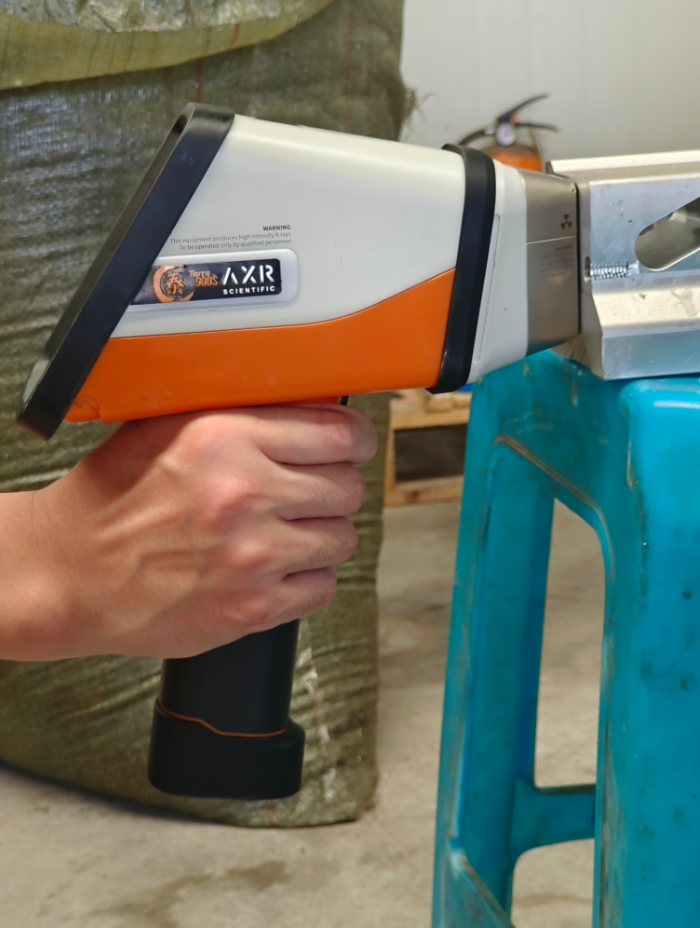
The AXR Terra900 series of handheld analyzers delivers laboratory-grade accuracy for rapid, non-destructive metal analysis. Featuring advanced electronics and algorithms, it provides results in seconds with minimal training or sample preparation, and effortlessly handles solids, liquids, and powders. It is the ideal solution for alloy identification, scrap sorting, quality control, and Positive Material Identification (PMI) across a wide range of industries.
Choose a Portable XRF if your primary need is speed, mobility, and on-site decision-making for identification and screening.
Choose a Benchtop XRF if your primary need is maximum analytical precision, high-throughput of prepared samples, and data for formal reporting.
By aligning the tool's core strengths with your operational needs, you'll invest in the right technology to enhance productivity, ensure quality, and drive informed decisions.
 Your location:
