

Imagine being able to point a device at a piece of metal, a rocky outcrop, or even a piece of jewelry, and within seconds know exactly what it is made of. This isn‘t science fiction; it’s the power of handheld X-Ray Fluorescence (XRF) technology.
Often described as a "superpower" for material analysis, handheld XRF analyzers have revolutionized fields from scrap metal recycling to archaeology. In 2025 alone, the demand for these devices remained incredibly high, with significant investments from industries requiring precise material composition data . But how does this pocket-sized laboratory actually work? Let’s break it down into simple, understandable steps.
At its core, XRF is a non-destructive analytical technique used to determine the elemental composition of a material . "Non-destructive" means the sample being tested remains intact—no cutting, crushing, or dissolving required.
The process is based on a fundamental principle of physics: every element has its own unique atomic fingerprint.
When you shine a high-energy X-ray on a material, it causes the atoms inside to emit their own characteristic secondary (or fluorescent) X-rays. By measuring the energy and intensity of these returning rays, the analyzer can tell you exactly which elements are present and in what concentration .

While the physics sounds complex, the process inside a handheld analyzer is a seamless series of events that takes just seconds. Here is the step-by-step breakdown of how XRF technology works :
It all starts when you pull the trigger. The handheld analyzer generates a beam of high-energy X-rays from an internal X-ray tube and directs it toward the sample surface .
When these primary X-rays hit the atoms in the sample, they have enough energy to knock out electrons from the atom's inner shells (like the K or L shell). This leaves the atom in an unstable, excited state .
Nature hates instability. To return to a stable state, an electron from a higher-energy outer shell immediately jumps down to fill the vacant spot in the inner shell. In order to make this jump, the electron must release energy. It does so by emitting a fluorescent (or secondary) X-ray . This is the "fluorescence" in XRF.
The fluorescent X-rays emitted by the sample travel back into the analyzer, where they are collected by a detector. This detector acts like a high-speed camera for X-rays, capturing each one and sending an electronic pulse to the device’s digital signal processor .
This is where the magic happens. The energy of each returning fluorescent X-ray is unique to the specific element it came from—it is that element’s fingerprint. The processor measures this energy to identify the element (qualitative analysis) and counts how many of these X-rays arrive to determine how much of that element is present (quantitative analysis) .
Finally, the Central Processing Unit (CPU) analyzes the spectral data and displays the results clearly on the screen. Within seconds, you are looking at a full chemical breakdown of your sample, often complete with alloy grades or concentration levels .
To make this process happen, a handheld XRF analyzer relies on three critical pieces of hardware :
The X-Ray Source: This is usually an X-ray tube (often with targets like Rhodium or Silver) that generates the primary X-rays needed to excite the sample .
The Detector: The "eye" of the device. Modern handheld analyzers use advanced detectors like Silicon Drift Detectors (SDD), which offer high sensitivity and fast processing speeds, allowing them to detect even trace elements .
The Data Processing Unit: The brain of the operation. This includes the software and algorithms that interpret the signals from the detector, correct for interferences, and translate them into readable results on the display .
The beauty of this technology lies in its combination of laboratory-grade accuracy and on-the-spot speed. Here is how different industries are using it:
Scrap Metal Recycling: Instantly sort and grade metals like aluminum or stainless steel (e.g., telling apart 304 and 316 stainless steel in seconds) to ensure fair pricing and efficient processing .
Mining and Exploration: Geologists use it in the field to analyze soil and rock outcrops, identifying potential mineral deposits in real-time and drastically reducing lab costs .
Precious Metals & Jewelry: Pawn shops and traders use XRF to verify the karat of gold or platinum and even detect thin gold plating on counterfeit items, preventing fraud .
Environmental Testing: Quickly screen soil for heavy metal contaminants like lead, arsenic, or cadmium, which is essential for remediation projects .
Manufacturing & Quality Control (PMI): Factories use it for Positive Material Identification (PMI) to ensure that pipes, valves, and other components are made from the correct alloy before installation, preventing catastrophic failures .
Despite using X-rays, handheld analyzers are very safe when used correctly. They are designed with multiple safety shutters and require pressure on the trigger to operate. Modern devices meet stringent global safety standards, and the exposure levels for users are negligible when basic protocols are followed
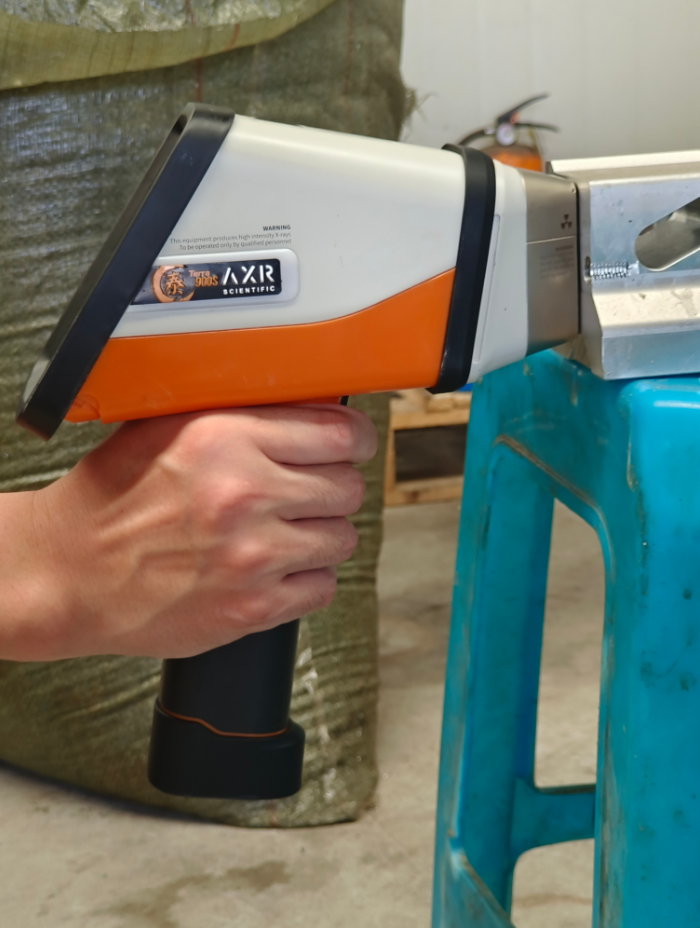
The AXR Terra900 series of handheld analyzers delivers laboratory-grade accuracy for rapid, non-destructive elemental analysis. Equipped with advanced electronics and intelligent algorithms, it provides reliable results within seconds—requiring minimal training and virtually no sample preparation. Capable of analyzing solids, liquids, and powders with ease, the Terra900 is the ideal solution for alloy identification, scrap sorting, quality control, and Positive Material Identification (PMI) across diverse industries.
As detector technology improves and software becomes smarter, handheld XRF analyzers are becoming faster, lighter, and more sensitive than ever. Newer models can now analyze lighter elements with greater stability and connect wirelessly to cloud systems for real-time data management .
From the scrap yard to the museum, handheld XRF has democratized chemical analysis. It puts the ability to see the invisible building blocks of our world directly into the hands of the people who need it most.
 Your location:
