

Gold has always occupied a special place in human history, symbolizing wealth, power and luxury. Whether used to create fine jewelry or as a store of value, the purity of gold is critical. Gold has long been regarded as a symbol of wealth and luxury. Its rarity and beauty have made it highly sought after throughout history. However, ensuring the purity of gold is crucial, as even minor impurities can significantly affect its quality and value. Advanced gold purity testing machine technology plays an important role in accurately detecting impurities and verifying the authenticity of this precious metal. Detecting impurities in gold has been a long-standing challenge, but as technology advances, we now have some powerful tools that have revolutionized the process of gold purity testing. In this article, we explore the importance of gold purity, traditional testing methods, and the transformative impact advanced technology is having in ensuring the authenticity of this precious metal.
The Importance of Gold Purity
The value of gold is directly tied to its purity. Pure gold is considered 24 karat, meaning it contains 24 parts pure gold. However, gold is often alloyed with other metals to enhance durability or change its color. The karat scale, from 1 to 24, indicates the percentage of pure gold in a given piece of gold. For example, 18 karat gold contains 75% pure gold. Ensuring the accuracy of these purity levels is critical to both buyers and sellers in the gold market.
Jewelers and goldsmiths have long used traditional methods to assess the purity of gold. In the past, gold purity testing mainly relied on traditional methods such as acid testing and stone testing. These methods involve using corrosive acids or rubbing gold against stone and observing the resulting color or marks. While these methods are still used today, they are subjective and susceptible to human error. Acid testing involves applying nitric acid to small scratches on the gold surface and watching the reaction. While this method is effective, it is invasive and can damage the metal. Advanced technology has revolutionized gold purity testing, providing more accurate and reliable results. Additionally, electronic gold testers measure the conductivity of metal to determine its purity. Although these methods have been historically reliable, they have their limitations.

Laser-induced breakdown spectroscopy (LIBS) is another cutting-edge technology applied to gold purity testing. By using laser pulses to induce a plasma on the gold surface, LIBS can identify the elemental composition of gold. This method is fast, non-destructive and allows precise measurements to be made, ensuring the accuracy of gold purity assessments.
ICP-MS is a highly sensitive technique for detecting and quantifying trace elements in gold samples. The method involves using a high-temperature plasma to ionize the sample and then separating the ions based on their mass-to-charge ratio. By measuring the mass and abundance of different ions, ICP-MS can identify trace impurities present in gold. The technology is critical to ensuring the highest purity for gold used in specialized applications such as electronics and medical devices.
LA-ICP-MS is an advanced technology that combines laser ablation with ICP-MS analysis. In this method, a laser is used to evaporate tiny portions of the gold sample, which are then brought into an ICP-MS instrument for analysis. LA-ICP-MS has high spatial resolution and can detect and map impurities in different areas of a gold sample. This technique is valuable for assessing the uniformity and quality of large gold bars or intricate jewelry pieces.
Ultrasonic testing is a non-destructive method that uses high-frequency sound waves to assess the integrity and purity of gold. By measuring the speed of sound waves passing through a gold sample, voids, cracks or other structural defects can be identified. Ultrasonic testing can also be used to determine the thickness of metal coatings to ensure they meet specific quality standards.
Non-destructive: Unlike traditional methods, advanced technologies such as XRF and LIBS allow for non-destructive testing, protecting the integrity of valuable gold pieces.
Precision and Accuracy: These techniques provide highly accurate results, reducing the margin of error in gold purity assessment.
Time efficiency: Traditional testing methods can be time-consuming. Advanced technology provides rapid results and simplifies the gold testing process.
Broad applicability: XRF and LIBS can be used on all forms of gold, including jewelry, coins and gold bars, making them universal tools for goldsmiths, jewelers and gold bar traders.
In recent years, advances in technology have introduced non-destructive and highly accurate methods of testing gold purity. X-ray fluorescence (XRF) technology is one of them. An XRF analysis instrument emits X-rays at the gold sample, causing it to fluoresce. The emitted energy is then analyzed to determine the elemental composition and purity of the gold without damaging the gold piece. This technology provides fast and highly accurate results, becoming one of the revolutionary tools in the field of gold testing. This non-destructive method involves shining X-rays on a gold sample, causing the atoms in the gold to emit characteristic fluorescent X-rays. By analyzing the energy and intensity of these X-rays, the machine can determine the elemental composition and purity of the gold. XRF technology provides fast and accurate results and is an important tool for gold testing laboratories and refineries.
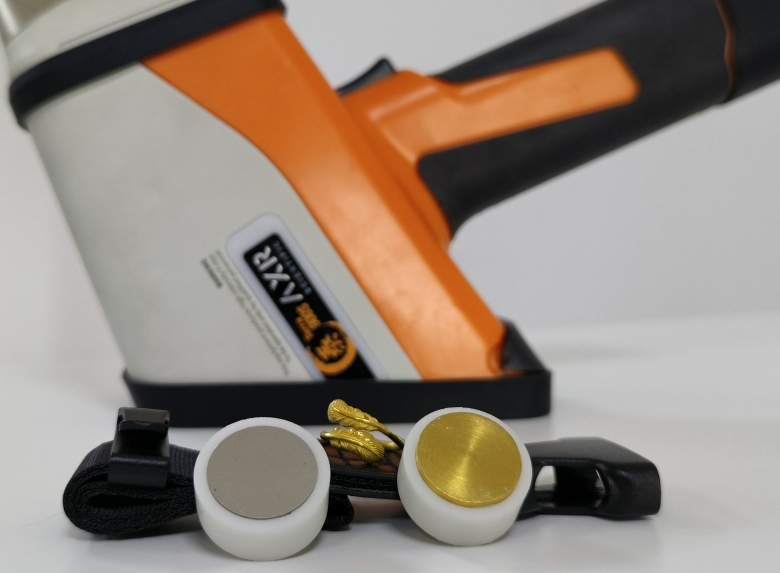
Terra990 handheld precious metal analyzer is widely used in precious metal recycling industry, jewelry industry, etc. It can also be used for purity identification of precious metals, gold and silver, and industrial precious metal catalyst industry. Terra990 uses a ceramic package micro-focus X-ray tube, a silver target of 50KV, a high-performance Si-Pin detector/SDD detector (graphene window), a resolution of 140eV FWHM/129eV FWHM, and a kapton window film, optional Carbon fiber anti-puncture window, collimator 5mm (optional 3mm), CPU is i.MX 8M Mini quad-core 1.8GHz, multi-channel processor is 4096 pixel multi-channel analyzer/80 MHz ADC digital signal processor, detection The output limit can reach 2pmm, and the thinnest test can be 0.005μm. The coating thickness is generally within 50μm (each material is different). Repeatability: up to 0.1%. It has a unique AXRUNI mechanism design, which effectively increases the heat dissipation of the light tube and integrates CCD. Microscopic camera with auto-focus lens, used to locate and record the location of measuring points, analyze elements Au, Ag, Pt, Pd, Rh, Ru, Ir, Zn, Cu, Ni, Co, Fe, which can be added as needed.
As demand for gold continues to grow, ensuring the authenticity of this precious metal is vital. The evolution of gold purity testing technology, with the introduction of technologies such as XRF and LIBS, represents significant advances in accuracy, efficiency and non-destructive testing. These advancements allow industry professionals and consumers alike to be confident in the purity of their gold investments. In a context where precious metals are constantly evolving, embracing advanced technology ensures that gold will always be synonymous with purity and quality.
 Your location:
