

Gold has captured the imagination of humanity for centuries with its intrinsic beauty, value, and historical significance. The accurate determination of the purity of gold is of utmost importance, whether it's for crafting exquisite jewelry, validating investments, or verifying the authenticity of precious artifacts. Over time, the methods used for gold purity test have evolved from traditional techniques to modern technology-driven approaches, revolutionizing the way we ascertain the quality of this precious metal.
Long before the advent of sophisticated analytical instruments, our ancestors devised ingenious methods to assess the purity of gold. Some of the traditional methods employed include:
Touchstone and Acid Testing: A touchstone—a black stone with a finely polished surface—was used as a test surface. A small streak of the gold alloy to be tested was rubbed against the touchstone, and nitric acid was applied to the streak. The acid's reaction with the gold would determine its purity based on the observed color changes.
Fire Assay: This ancient method involves melting the gold alloy and separating the impurities through various chemical reactions. The remaining pure gold was then weighed to calculate its purity.
Density Testing: Gold's high density was exploited in this method. The gold piece's weight and volume were measured, and its density was compared to that of pure gold.
Modern Technology: A Leap into Precision
As technology advanced, so did the techniques for gold purity testing. Modern methods offer increased accuracy, speed, and non-destructive analysis. Some contemporary methods include:
Mass Spectrometry: Mass spectrometry enables the determination of the elemental composition of materials, making it ideal for identifying gold and other metals.
X-Ray Fluorescence (XRF): XRF involves bombarding the sample with X-rays and measuring the emitted fluorescent X-rays. The spectrum of X-rays provides information about the elements present in the sample, allowing for non-destructive analysis of gold purity.
Atomic Absorption Spectroscopy (AAS): AAS measures the absorption of light by atoms in a sample. This method can detect and quantify metal elements, including gold, in various materials.
Electrochemical Methods: Electrochemical analysis and sensors can detect metal ions, offering high sensitivity and selectivity in determining the presence of gold.
Surface Plasmon Resonance (SPR): SPR technology detects changes in the resonance angle of light reflected off a metal surface. It is used to detect and quantify gold nanoparticles and thin films.
Nanoparticle Labeling: Nanoparticles tagged with specific detection agents can be used to identify the presence of gold. Changes in the nanoparticles' properties indicate the presence of gold in a sample.
The utility of XRF in detecting gold lies in the distinctive fluorescent X-rays that gold emits when exposed to X-ray radiation. Gold possesses specific energy levels at which its electrons absorb and re-emit X-ray energy. As a result, the emitted X-rays are of discrete energies, directly correlating to the presence of gold in a sample. This characteristic signature enables XRF instruments to not only identify the presence of gold but also determine its concentration, thus providing valuable information about the sample's purity.
Non-Destructive: One of the most significant advantages of XRF is its non-destructive nature. XRF analysis does not require physical alteration or sample preparation, making it an ideal method for assessing the purity of precious artifacts, jewelry, and historical objects without causing damage.
Speed and Efficiency: XRF analysis is rapid, often providing results within minutes. This speed is especially advantageous in scenarios where quick decisions or assessments are required.
High Sensitivity: Modern XRF instruments offer high sensitivity, allowing them to detect trace amounts of gold even in complex matrices.
Versatility: XRF is not limited to gold detection; it can simultaneously analyze multiple elements within a sample, providing comprehensive information about its composition.
Portable Instruments: Portable XRF devices have become increasingly available, enabling on-site analysis in diverse environments, such as archaeological sites, jewelry stores, and mining operations.
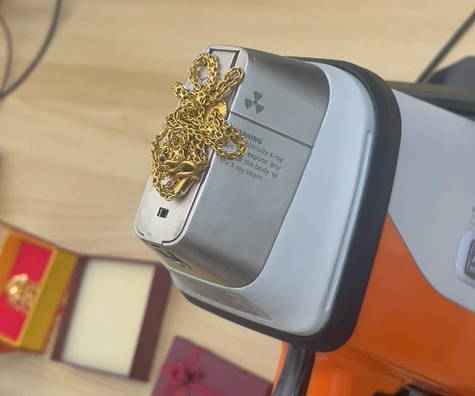
XRF's applications in the realm of gold detection are diverse. It is extensively used in jewelry authentication, precious metal trading, quality control in manufacturing, and archaeological research. Additionally, XRF aids in compliance with regulatory standards for gold content in products, ensuring consumer protection and fair trade practices.
The Terra 990 Handheld XRF Precious Metal Analyzer provides a complete solution for elemental analysis in the production, sale and recycling of precious metal products. The instrument is equipped with a high-performance X-ray excitation device and Si-PIN detector, which can achieve accurate quantitative analysis. Customers can also choose a silicon drift detector (SDD) to improve the resolution of the instrument and reduce the time required for analysis.
In conclusion, X-ray fluorescence spectroscopy (XRF) has proven itself as an indispensable tool for detecting gold and assessing its purity. With its non-destructive nature, speed, accuracy, and versatility, XRF continues to play a pivotal role in various industries, safeguarding the integrity of gold products and contributing to the scientific understanding of this captivating precious metal.
 Your location:
