

In the realm of material analysis, the emergence of handheld metal spectrometer technology has heralded a new era of mobility and efficiency. These portable devices, once regarded as technological marvels, are now reshaping the landscape of metal analysis for scientists, engineers, and professionals across various industries. Metal analysis plays a crucial role in manufacturing, construction, and quality control, among other sectors. Traditionally, such analyses required complex laboratory equipment and time-consuming sample preparation. However, with the advent of handheld metal spectrometers, metal analysis has become portable, efficient, and highly precise. This article will comprehensively delve into the advancements in handheld metal spectrometer technology, exploring its impact on metal analysis and the flexibility it brings to professionals.
Traditionally, metal analysis demanded bulky and fixed equipment, typically confined to laboratory environments. The introduction of handheld metal spectrometers has revolutionized this process by bringing analytical capabilities directly to the field. These portable devices utilize advanced spectroscopy techniques to swiftly identify and quantify elements present in metal samples with remarkable accuracy.
One notable feature of handheld metal spectrometers is their portability. Unlike their stationary counterparts, these devices are compact, lightweight, and specifically designed for on-the-go analysis. This newfound flexibility enables professionals to conduct metal analysis directly at the source, eliminating the need to transport samples to central laboratories. Whether in manufacturing facilities, construction sites, or remote wilderness areas, handheld metal spectrometers provide real-time results, significantly reducing analysis time and enhancing overall efficiency. These compact devices are easy to carry and operate, eliminating the requirement to transport samples to the laboratory, saving time, and reducing the risk of sample contamination or degradation. With portable metal spectrometers, engineers, inspectors, and researchers can perform real-time metal analysis in production sites, construction sites, or any location, improving efficiency and decision-making capabilities. Portable metal spectrometers utilize advanced technologies such as Laser-Induced Breakdown Spectroscopy (LIBS) or X-ray Fluorescence (XRF) to provide rapid and accurate metal analysis. LIBS-based spectrometers use lasers to generate plasma on the surface of metal samples, emitting characteristic light. By analyzing the emitted light, the spectrometer can identify elements in the sample and determine their concentrations. XRF-based spectrometers use X-ray radiation to excite atoms in the sample and analyze the generated fluorescent X-rays to determine the elemental composition. Both technologies offer quick analysis results, usually within seconds, without compromising accuracy.
Handheld metal spectrometers find applications across various industries, with each benefiting from the portability and efficiency these devices provide. For instance, in manufacturing, these spectrometers are used to verify the composition of raw materials, ensure quality control, and prevent product defects. In the fields of construction and engineering, professionals can swiftly assess the metal composition of structural elements, aiding in material selection and integrity assessment. The versatility of handheld metal spectrometers extends to archaeology, where rapid on-site analysis of metal artifacts provides valuable insights into historical metallurgy. Similarly, environmental monitoring benefits from the ability to analyze metal pollution in soil, water, and air, aiding in pollution control and resource management. These spectrometers can analyze various types of metals, including ferrous alloys, non-ferrous alloys, precious metals, and even light elements. They are used for material verification, quality control, metal sorting and recycling, as well as the identification of unknown or substandard alloys. In the aerospace industry, portable metal spectrometers assist in inspecting whether aircraft components comply with regulatory standards. In the automotive sector, they ensure the quality and composition of critical components. The multifunctionality of portable metal spectrometers makes them an indispensable tool for metal analysis across various industries.
The evolution of handheld metal spectrometer technology not only brings portability but also significantly enhances accuracy and reliability. Early versions faced challenges in providing precise results, especially for trace elements. However, continuous research and development efforts have led to improved algorithms, advanced detector technologies, and enhanced calibration methods, ensuring that modern handheld metal spectrometers deliver highly accurate and reliable analyses across a wide range of metal compositions.
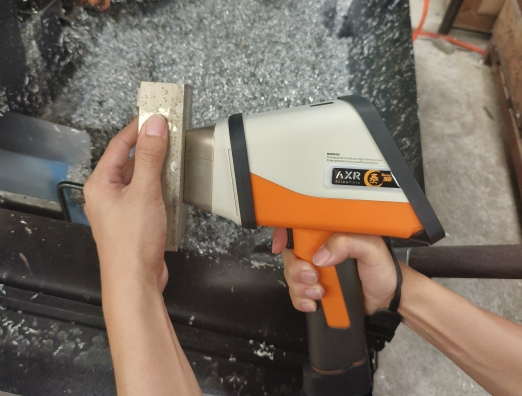
To make these sophisticated devices accessible to a broader range of professionals, manufacturers have prioritized user-friendly interfaces. Intuitive controls and simplified menus enable users with varying levels of expertise to operate handheld metal spectrometers efficiently. Additionally, modern devices come equipped with advanced data management features, allowing users to organize, store, and analyze large datasets seamlessly. This seamless integration with data management systems enhances overall usability and facilitates informed decision-making processes.
Portable Spectrometer for metal analysis such as AXR Terra series Handheld XRF Analyzers are good choice for analysis in many fields, delivering rapid, accurate results right in your hand. It is the ideal solution for checking and analyzing alloy, precious metals, coating thickness, soil, lithium battery etc. anytime anywhere with a fast and a non destructive way. Take scrap sorting as an example, The AXR Scientific Terra900 Handheld Alloy Analyzer can detect the composition and concentration of scrap metal purchased on site, and can sort out accurate metal grades to improve the utilization rate of scrap metal.AXR Scientific Terra900 portable alloy Analyzer or handheld xrf gun provides maximum efficiency in the analysis and sorting of metal alloys. Due to its speed, non-destructive nature and minimal requirements for sample preparation, because XRF is more versatile and convenient than the optical emission method.The FP method is applicable to all existing types of alloys, which makes it indispensable in metallurgy, foundry, mechanical engineering and other areas.Fast and onsite analysis of the composition of alloys is carried out when scrap yard performing the following works, which is not only involves in the scrap yards but also the buyer of the scrap and foundry and metal factories.
With the continuous advancement of handheld metal spectrometer technology, the mobility of metal analysis has brought portability, efficiency, and heightened accuracy to professionals across various industries. The ability to perform analyses on-the-go has transformed the way we assess metal compositions. As innovation continues, the future of handheld metal spectrometers holds the promise of delivering even more robust capabilities, further expanding their application areas, and solidifying their indispensable position in the field of material analysis. The journey towards mobile and precise metal analysis is ongoing, placing powerful technology directly into the hands of those unraveling the mysteries of metal compositions.
 Your location:
