

In the fast-paced world of industrial production, ensuring product quality is crucial. Industrial quality assurance (QA) processes play a vital role in maintaining high standards, meeting regulatory requirements and ultimately meeting customer expectations. Quality assurance processes play a key role in maintaining product standards and meeting customer expectations. One technology leading a revolution in industrial quality assurance is the portable X-ray fluorescence (XRF) instrument. These handheld devices offer a range of benefits to maximize productivity and efficiency in quality control. One innovative tool that is revolutionizing the QA landscape is the portable X-ray fluorescence (XRF) gun. In this article, we will explore the capabilities of portable XRF guns and how they can help maximize productivity in industrial settings.
XRF technology has been widely used in various industries, including mining, metals, manufacturing and environmental monitoring, for elemental analysis. Variants of portable XRF take this technology to the next level by providing a handheld, user-friendly device that can be taken directly to the point of interest. The operation of these devices is based on the principle of X-ray fluorescence. When X-rays illuminate a sample, the atoms in the material respond by emitting characteristic X-ray fluorescence. By measuring the energy and intensity of these emitted X-rays, the device can identify and quantify the elemental composition of the sample.

Portability and on-site analysis: Portable XRF guns allow analysis to be performed in the field, eliminating the need to transport samples to a laboratory. This not only saves time, but also provides real-time data, allowing decisions in the production process to be implemented quickly. An important advantage of portable XRF instruments is their ability to provide real-time material analysis. These devices use X-ray technology to determine the elemental composition of a material in seconds. Compared to traditional laboratory methods, which require time-consuming sample preparation and waiting for results, portable XRF instruments enable instant analysis. This instant feedback enables quality control professionals to make quick decisions, identify potential problems and take corrective action in a timely manner.
Fast and non-destructive testing: One of the outstanding features of portable XRF guns is their ability to provide fast and non-destructive testing. Samples can be analyzed without altering or damaging them, making it an ideal solution for maintaining product integrity during quality assurance. Portable XRF instruments have the capability of non-destructive testing, which is an important advantage for industrial quality assurance. They allow material analysis without causing any damage or alteration. This feature is particularly valuable when testing expensive or limited-supply samples. By avoiding destructive testing methods, portable XRF instruments minimize material waste and reduce the need for additional testing, thereby optimizing productivity.
Multi-element analysis: These devices are capable of analyzing multiple elements in a sample simultaneously. This capability is invaluable in industries that require close monitoring of the presence and concentration of various elements to meet quality standards.
Cost-effective: Although the initial investment in portable XRF technology may seem substantial, the long-term benefits often outweigh the costs. The ability to conduct on-site testing reduces the need for expensive laboratory facilities and reduces turnaround time for results. The user-friendliness of portable XRF instruments simplifies quality assurance workflows. These devices are designed with an intuitive interface and simple operation, allowing operators of all skill levels to use them effectively. The form of the handheld device allows for flexible movement and facilitates material testing at different locations on the production site. Streamlined workflows reduce learning costs, shorten training time, and increase overall productivity.
Portable XRF instruments have a wide range of applications in various industries. They can analyze a variety of materials, including metals, alloys, plastics, ceramics, and more. This versatility makes them an indispensable tool for quality assurance in manufacturing, construction, aerospace, automotive, and more. Whether verifying material composition, detecting contaminants or ensuring compliance with regulatory standards, portable XRF instruments provide comprehensive solutions to maximize productivity in diverse industrial environments.
Metals and Alloys: Portable XRF guns are widely used in the metals and alloys industry to verify material composition and ensure the correct alloy is used in the production process.
Mining and Exploration: In mining and exploration, these devices are used to quickly assess ore quality and aid in decision-making regarding matters related to resource extraction and processing.
Environmental Compliance: Industries dealing with environmental monitoring use portable XRF guns to evaluate soil and water samples to ensure compliance with environmental regulations.
Manufacturing Processes: Quality assurance processes in manufacturing benefit from the real-time data provided by portable XRF guns, allowing adjustments to be made quickly to maintain product quality.
Modern portable XRF instruments are equipped with advanced software platforms for easy data management and report generation. These platforms enable seamless organization, storage and analysis of test results.
Quality control professionals can generate comprehensive reports, track trends, and identify areas for improvement. The portable XRF instrument’s efficient data management and reporting capabilities enhance productivity by providing valuable insights that help understand material quality and simplify the decision-making process.
So, how do you choose the most suitable portable XRF instrument for your needs? Selecting the right portable XRF instrument involves considering multiple factors, including the application area, range of elements, performance requirements, sample types, portability, analysis speed, data processing and software, budget, support and training, safety standards, user feedback, and upgradability, among others. Based on these criteria, it is highly recommended to consider the various series of handheld analyzers from the AXR brand. This brand offers a wide range of applications, nearly covering all the application areas mentioned earlier. It can detect a range of elements, including Ti, V, Cr, Mn, Fe, Co, Ni, Hf, Ta, Re, Cu, Zn, W, Se, Pb, Bi, Zr, Nb, Mo, Al, Pd, Ag, Sn, Sb, and more, depending on the mode. The detectors used are High-performance Si-Pin detectors or Optimized SDD detectors. These instruments are suitable for a wide variety of sample types, are compact and lightweight, highly portable, provide fast analysis (typically 15 to 30 seconds per test), have reasonable software update frequencies, offer excellent value for money, and provide product training and regular updates. User feedback rates are above 95%, making it one of the most popular brands in its category.
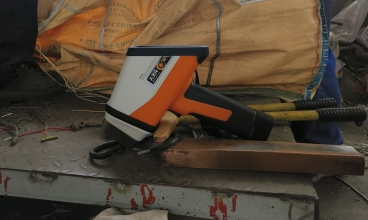
Integrating portable XRF guns into industrial QA processes represents a major leap in efficiency, accuracy and affordability. As industries strive to meet ever-increasing quality standards, the ability to perform on-site, rapid and non-destructive elemental analysis is a game-changing innovation. Portable XRF technology enables manufacturers and QA professionals to make informed decisions that ultimately maximize productivity and contribute to the overall success of industrial operations. Embracing this innovative tool is not only an investment in technology, but an investment in the future of quality assurance.
 Your location:
