

In the world of scientific analysis, few tools have quietly revolutionized as many industries as the X-ray Fluorescence (XRF) instrument. From uncovering the secrets of ancient artifacts to ensuring the safety of modern consumer goods, this technology has become a cornerstone of material science. Its journey from a complex laboratory curiosity to a portable, indispensable tool is a fascinating tale of scientific ingenuity and technological refinement.
The story of XRF begins with the discovery of X-rays themselves. In 1895, Wilhelm Conrad Röntgen observed a mysterious radiation that could pass through solid objects and fog photographic plates. This monumental discovery earned him the first Nobel Prize in Physics in 1901 and set the stage for deeper exploration.
The specific phenomenon of X-ray fluorescence was first explained in 1923 by the Irish physicist John Joly. He theorized that when a material is bombarded with high-energy X-rays, its atoms become excited and emit secondary (or "fluorescent") X-rays of characteristic energies. These emitted energies act as a unique fingerprint, identifying the elements present in the sample. This principle became the bedrock of XRF analysis.
The leap from theory to practical instrument came in the post-World War II era, driven by advancements in electronics and detector technology. The first commercial XRF spectrometers emerged in the late 1940s and early 1950s. These were Wavelength-Dispersive XRF (WDXRF) systems.
These early behemoths were complex, room-sized machines. They worked by using a crystal to diffract the fluorescent X-rays, separating them by wavelength (much like a prism separates light) before measuring their intensity with a detector. While incredibly precise, they were slow, required expert operators, and needed carefully prepared, homogenized samples. Their use was confined to well-funded industrial and research laboratories, primarily for quality control in metallurgy and mining.
The 1960s and 70s brought a transformative breakthrough: the Energy-Dispersive XRF (EDXRF) spectrometer. This was made possible by the development of semiconductor detectors, like lithium-drifted silicon [Si(Li)] detectors.
Unlike WDXRF, EDXRF instruments eliminated the moving crystal. Instead, the detector measured the energy of all incoming fluorescent X-rays simultaneously and used a multi-channel analyzer to sort and count them. This made analysis dramatically faster—from tens of minutes to seconds. While early EDXRF had slightly lower resolution than its wavelength-dispersive cousin, its speed, simplicity, and ability to analyze irregular samples opened doors to new applications.
The most profound shift in the XRF narrative began in the 1980s and accelerated into the 21st century: miniaturization. Advancements in microelectronics, miniaturized X-ray tubes, and sophisticated software led to the development of handheld and portable XRF analyzers.
This was a game-changer. For the first time, non-destructive, lab-quality elemental analysis could be performed anywhere:
On a mining face to make real-time ore grade decisions.
At a scrap yard for instant alloy sorting and recycling.
On the factory floor for verifying incoming materials and finished products.
At an archaeological dig to characterize artifacts without damaging them.
In the field for environmental screening of soil contaminants.
Portable XRF democratized elemental analysis, putting powerful analytical capabilities into the hands of field technicians, archaeologists, and industrial inspectors.
Today's XRF instruments, both benchtop and handheld, are marvels of modern engineering. They feature:
Extreme Sensitivity: Capable of detecting elements from magnesium (Mg) to uranium (U) at parts-per-million (ppm) levels.
Robust Fundamental Parameters (FP) Software: This allows for accurate analysis without always needing calibration standards for every material type.
Advanced Detectors: Like silicon drift detectors (SDD), which offer even better resolution and speed at room temperature.
Connectivity and Data Management: Integrated GPS, cameras, Wi-Fi, and Bluetooth enable seamless data transfer, geotagging, and integration with laboratory information management systems (LIMS).
User-Centric Design: With intuitive touchscreen interfaces and results that are easier than ever to interpret.
The evolution of XRF has fueled its adoption across a staggering range of fields:
Cultural Heritage: Verifying the authenticity of paintings, analyzing ancient pottery glazes, and preserving historical monuments.
Environmental Protection: Monitoring lead in soil, screening for toxic elements in consumer products (e.g., RoHS compliance in electronics), and analyzing air filters.
Geology & Mining: From exploration and core logging to ore processing and mine remediation.
Manufacturing & Metals: Ensuring the integrity of aerospace alloys, sorting thousands of metal grades, and controlling plating thickness.
Food Safety: Screening for contaminants like heavy metals in agricultural products.
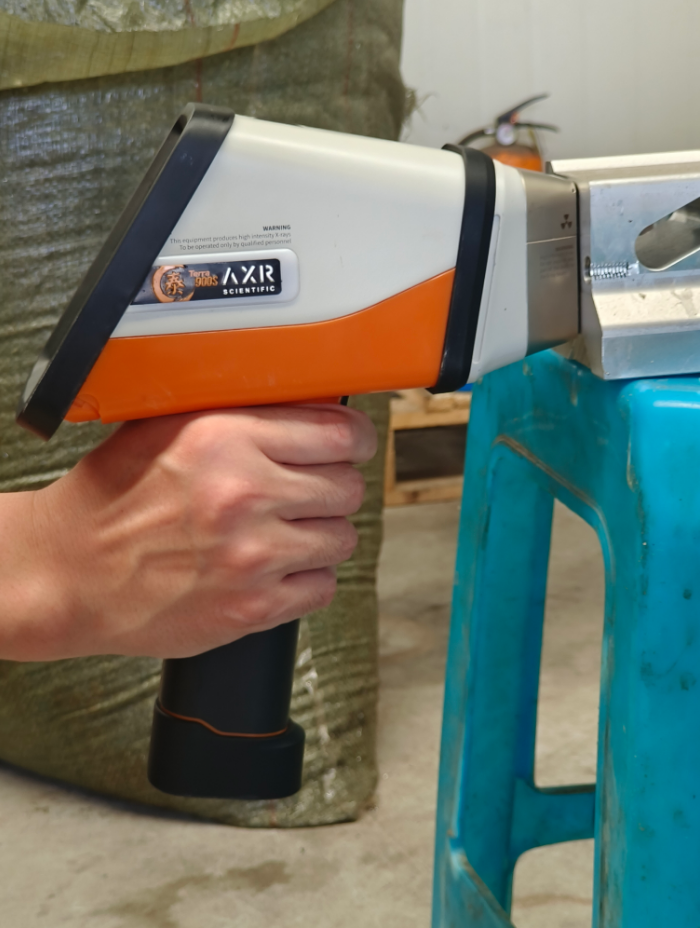
Lab precision meets field portability with the Terra900 XRF Spectrometer. This robust instrument detects elements from Mg to U, enabling rapid, non-destructive testing for alloy verification, scrap sorting, and contaminant screening. Its intuitive touchscreen and built-in Wi-Fi/USB connectivity streamline reporting, essential for quality control and environmental monitoring.
The evolution of XRF is far from over. The frontier now lies in even greater miniaturization (smartphone-sized analyzers are on the horizon), enhanced artificial intelligence for automated material identification and classification, and the integration of XRF data with other spectroscopic techniques for a more complete material "fingerprint."
From its origins in the foundational physics of the early 20th century to its current status as a ubiquitous tool for elemental analysis, the XRF instrument's history is a testament to the power of a brilliant idea, relentlessly refined. It has evolved from a precision instrument locked in a lab to a key of precision held in the hand, unlocking elemental truths about our world wherever we go. Its journey is a perfect example of how scientific tools evolve to not only answer our questions but to inspire new ones, driving discovery and quality forward in countless aspects of modern life.
 Your location:
