

If you work in manufacturing, archaeology, or geology—or if you are just a fan of crime scene investigation shows—you have likely heard of an XRF Spectrometer. But unless you are a chemist, the technology inside that box might seem like pure magic or, at the very least, incredibly complex.
The good news is that the principle behind XRF (X-Ray Fluorescence) is surprisingly intuitive. Once you understand the basics, you will see why this tool has become the gold standard for non-destructive material analysis.
Let’s demystify the XRF spectrometer and break down how it works, piece by piece.
Simply put, an XRF spectrometer is a device used to determine the elemental composition of a material. If you have a sample of metal, soil, paint, or even a piece of pottery, an XRF analyzer can tell you exactly what elements are inside it—from major components like iron and copper down to trace impurities.
Its superpower? It does all of this without destroying the sample.

To understand XRF, imagine you are in a dark room with a handful of glowing marbles. You want to know what color they are, but you cannot turn on the light. So, you throw a high-energy white marble into the mix. When the white marble hits a colored marble, that colored marble gets excited, jumps, and emits its own specific color of light.
In this analogy:
The white marble is the X-ray (the source).
The colored marbles are the atoms in your sample.
The color of light emitted is the "fluorescent" X-ray.
Because each element emits a unique fluorescent color (or energy signature), the spectrometer can identify exactly what elements are present.
Here is the step-by-step process of how a typical XRF spectrometer analyzes a sample:
Inside the handheld or benchtop device, there is an X-ray tube. When you pull the trigger or start the test, this tube generates a beam of high-energy X-rays and fires them directly at your sample. Think of this as "exciting" the sample.
The atoms in your sample are made up of a nucleus surrounded by electrons in specific shells (like layers of an onion). When the high-energy X-ray from the device hits an atom, it can knock an electron out of one of the inner shells.
This leaves the atom in an unstable, "excited" state.
To calm down, an electron from a higher-energy, outer shell jumps down to fill the gap.
When that outer electron jumps down, it has to release energy. It releases this energy in the form of a fluorescent X-ray.
Key Point: The energy released depends on which outer shell the electron came from and which inner shell it fell into. This is unique for every single element on the periodic table.
The spectrometer is equipped with a detector that acts as a highly sensitive "eye." It captures the fluorescent X-rays coming back from the sample.
It measures the energy of each returning X-ray.
If the energy level matches the signature of Iron, the detector notes "Iron detected."
If it matches Lead, it notes "Lead detected."
The device counts how many X-rays come in at each energy level. This data is compiled into a spectrum—a visual chart showing peaks at different energies.
The Position of the peak tells you which element it is (Qualitative Analysis).
The Height of the peak (or the count rate) tells you how much of that element is present (Quantitative Analysis).
The AXR Terra900 series of handheld analyzers delivers laboratory-grade accuracy for rapid, non-destructive elemental analysis. Equipped with advanced electronics and intelligent algorithms, it provides reliable results within seconds—requiring minimal training and virtually no sample preparation. Capable of analyzing solids, liquids, and powders with ease, the Terra900 is the ideal solution for alloy identification, scrap sorting, quality control, and Positive Material Identification (PMI) across diverse industries.
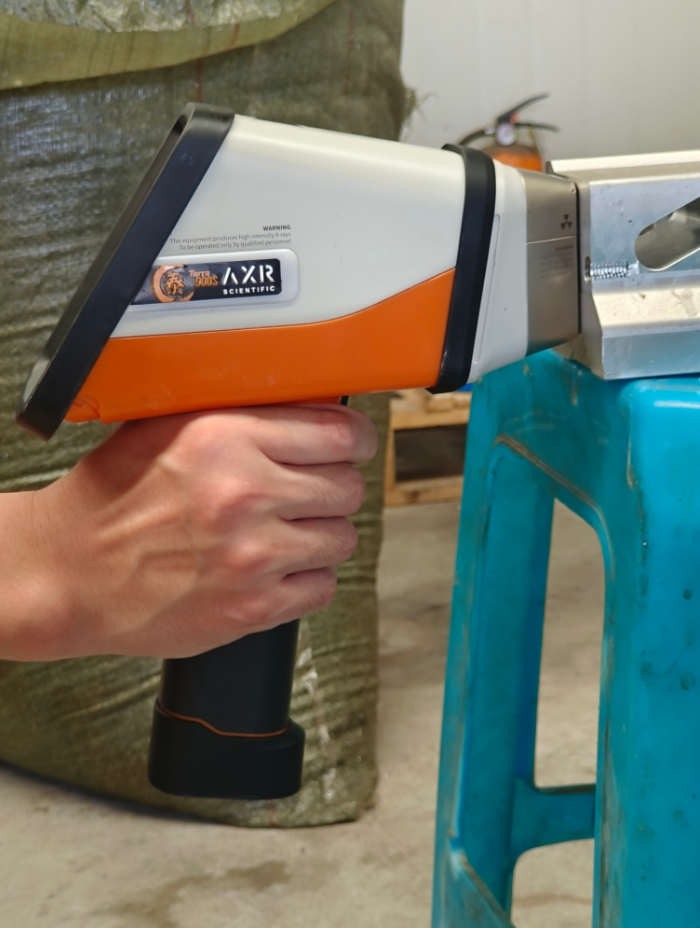
The XRF Spectrometer is essentially a sophisticated matchmaker between energy and matter. By sending energy into a sample and listening for the unique "echo" of each element, it reveals the hidden blueprint of the material world around us.
Whether it's verifying that a ring is solid gold, ensuring that soil is free of lead contaminants, or sorting scrap metal at a recycling yard, the magic of XRF is just applied physics.
 Your location:
