

The thriving development of materials science continues to propel advancements in technology and industry, and alloy analyzer guns stand out as a brilliant newcomer, shining in the field of materials analysis. In the past, we were accustomed to the laborious and time-consuming analysis of materials, but today, this process is undergoing a fundamental change at an unprecedented pace. Alloy analyzer guns, with their astonishing speed and accuracy, are leading us into a new era, enabling a complete shift in our perception of materials within a matter of seconds.
Traditional methods of materials analysis have often involved time-consuming and labor-intensive processes. From collecting samples to conducting complex laboratory tests, gaining an understanding of the composition and characteristics of various alloys has historically required a significant amount of time. However, with the advent of alloy analyzer guns, the speed of material analysis has taken a qualitative leap forward. At the core of this revolutionary technology lies advanced spectroscopic techniques. Alloy analyzer guns leverage technologies like X-ray fluorescence (XRF) to rapidly and non-destructively determine the elemental composition of materials. This means that with just a simple point-and-shoot action, these instruments can provide comprehensive data about the alloy composition within a matter of seconds.
The primary advantage of alloy analyzer guns lies in their speed. Traditional laboratory methods may take days or even weeks to yield results. In contrast, these portable devices can deliver accurate and reliable data almost instantaneously. This rapid feedback time is a game-changer for industries where decision times are crucial, such as manufacturing, construction, and aerospace. Alloy analyzer guns find applications across various industries. In manufacturing, they aid in ensuring the quality of raw materials and finished products, thereby enhancing production efficiency. In the construction industry, these instruments assist in on-site quality control, allowing for quick adjustments to prevent costly errors. In the aerospace industry, the ability to rapidly analyze alloys contributes to the safety and performance of critical components.
Another noteworthy aspect of alloy analyzer guns is their portability. Unlike traditional laboratory equipment, these handheld devices can be easily carried to different locations, becoming invaluable tools for on-site work and real-time analysis. This portability not only saves time but also enables real-time decision-making, reducing the need to shuttle samples back and forth between the field and the laboratory.
While speed is a critical factor, alloy analyzer guns do not compromise on accuracy and reliability. The technology behind these devices has been carefully refined to provide precise results, allowing engineers, scientists, and industry professionals to make informed decisions with confidence.
X-ray Fluorescence (XRF) technology is a non-destructive analytical technique used for determining the elemental composition of materials. This technique involves exposing a sample to X-ray radiation, causing the atoms in the sample to absorb some of the incident X-rays and re-emit X-rays of specific energies. The energy of the re-emitted X-rays is proportional to the types and quantities of elements present in the sample. By measuring the energy spectrum of these X-rays, the elemental composition of the sample can be determined.

Fluorescence X-ray Fluorescence (XRF): In this technique, the sample, when excited by X-rays, produces fluorescent radiation that is measured. The energy and intensity of the fluorescent radiation can be used to determine the types and concentrations of elements in the sample.
Energy-Dispersive X-ray Fluorescence (EDXRF): This is a spectroscopic analysis method where the energy spectrum of X-rays is measured to determine the presence and concentration of elements. This technique typically uses solid-state detectors to measure the X-ray spectrum emitted by the sample.
XRF technology finds wide applications in various fields, including geology, environmental monitoring, metallurgy, chemistry, pharmacy, archaeology, and more. Due to its non-destructive nature and relatively fast analysis speed, XRF technology is widely used in both laboratory and on-site analyses.
Currently, there are many handheld X-ray Fluorescence (XRF) alloy analyzers available in the market. These devices are designed for on-site, field, or rapid analyses and can be applied in areas such as quality control of metal alloys, metal recycling, mining and exploration, environmental monitoring, and more. These handheld XRF analyzers typically have the capability to rapidly analyze the elemental content of various elements in alloys within seconds to minutes. They often come with intuitive user interfaces for ease of operation, along with data storage and transmission capabilities for subsequent data analysis and report generation. Different models of these instruments may vary in performance, accuracy, and the range of elements analyzed.
The AXR Terra900 series is a great choice for metal analysis in many fields, providing results quickly and accurately in hand. Due to advanced electronic technology and mathematical algorithms, the Terra900 series provides the ultimate measurement quality in seconds, making it an ideal solution for inspecting and analyzing incoming materials, finished products, and parts in the production process, and a non-destructive method. Due to its easy operation, you can view the alloy grade and chemical composition on the touch screen display, and obtain laboratory quality chemical composition in just a few seconds. It requires minimal training and almost no sample preparation, making it suitable for samples of various shapes and sizes. Terra900 handheld applications are not limited to solids, but can also measure liquids and powders. The Terra900 series handheld alloy analyzer is widely used in alloy grade recognition and quality control, scrap metal recycling, precious metals, PMI, and other fields.
Taking the field of scrap metal recycling as an example, the AXR Terra900 series has been widely used in this field due to its excellent performance. In terms of the types of alloys, it can detect magnesium alloy, aluminum alloy, titanium alloy, stainless steel, low alloy steel, tool steel, cobalt alloy, nickel alloy, copper alloy, zinc alloy, precious metal alloy, brass, bronze, etc., including but not limited to the alloys listed above. In all aspects of application in the entire field, handheld alloy analyzers are applied in the following fields: classification and separation of non-ferrous metal and ferrous metal waste, material feeding control, including confirmation of ferroalloy, steel and alloy grades, composition control in the melting process, and certification analysis of metallurgical products. Therefore, it occupies an important position in the waste metal recycling industry.
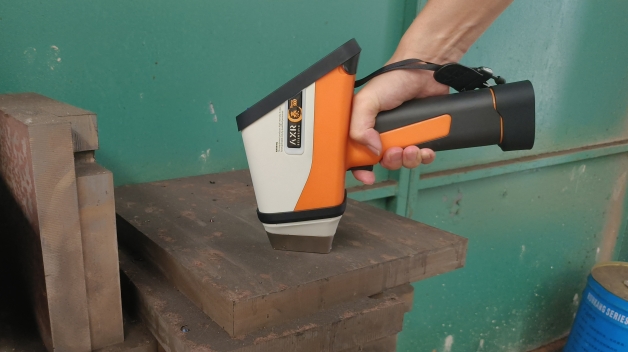
The alloy analyzer gun represents a paradigm shift in the field of material analysis, providing a perfect combination of speed, portability, and accuracy. With the continuous development of various industries, adopting such innovative technologies has become crucial for maintaining a leading position. The era of waiting for several days to obtain material analysis results is gradually passing, ushering in a new era for alloy analyzer guns, allowing us to understand and utilize the properties of alloys in just a few seconds.
 Your location:
