

In various industries, from mining and metallurgy to environmental monitoring and quality control, the need for accurate and efficient metal analysis is paramount. To meet these demands, portable metal analyzers have become indispensable tools. They offer the flexibility to conduct on-the-go testing, enabling professionals to make quick and informed decisions. However, with a wide range of options available in the market, selecting the right portable metal analyzer can be a daunting task. So, what should you do?
There are several crucial factors to carefully consider before purchasing an instrument: analyzing your requirements, assessing existing technologies, portability, battery life, durability, data management, maintenance, accessories, and budget. Defining your analytical requirements is of utmost importance before making a decision. Consider the type of metals or elements you need to analyze, the concentration levels, and the required detection limits. Some analyzers specialize in specific elements or may have detection limits that might not meet your needs. Ensure that the selected analyzer can meet your specific analytical requirements.
Portable metal analyzers employ various analytical techniques, including X-ray fluorescence (XRF), laser-induced breakdown spectroscopy (LIBS), and optical emission spectrometry (OES). Each technique has its strengths and limitations. XRF is suitable for a wide range of elements, offers non-destructive testing, while LIBS excels at rapid analysis of lightweight elements. OES is known for its accuracy and precision. Choose a technique that aligns with your analysis goals.
The primary advantage of portable metal analyzers is their mobility. Consider the weight, size, and ergonomics of the device. Look for features like comfortable grips and rugged construction, which can withstand harsh conditions.
Battery life is a critical factor when choosing a portable metal analyzer. A long-lasting battery is essential for uninterrupted fieldwork. Analyzers with extended battery life can significantly increase productivity and reduce downtime.
Depending on your intended use, you may need a portable metal analyzer that can withstand extreme conditions, such as high temperatures, humidity, or exposure to dust and chemicals. Look for analyzers with a high IP (Ingress Protection) rating, which indicates their resistance to environmental factors. Durable construction can save you money in the long run by reducing the need for frequent repairs or replacements.
A user-friendly interface is essential for efficient operation. Choose an analyzer with an intuitive interface, clear display, and straightforward menu options. Additionally, consider data management capabilities. Can the analyzer store and export data easily? This is especially important for compliance and quality control purposes.
Routine calibration and maintenance are necessary to ensure accurate results. Check if the portable metal analyzer offers user-friendly calibration procedures and easy access to necessary maintenance components.
Many portable metal analyzers come with a range of accessories and software options to enhance their functionality. Accessories like sample cups, stands, and protective cases can be valuable additions. Software may provide advanced data analysis tools, compatibility with industry-specific databases, or connectivity options for remote data transfer.
Portable metal analyzers come in a wide price range. It's important to balance your budget with your specific analytical needs. Keep in mind that while budget-friendly options may be appealing, investing in a high-quality analyzer can pay off in the long run by providing reliable and accurate results.

Portable metal analyzers utilize various principles to determine the presence and concentration of different elements in a sample. Here, we introduce three of them:
X-ray Fluorescence (XRF): XRF instruments operate based on the interaction of X-rays with the sample. When X-rays are directed onto the sample, they excite the atoms in the sample, leading to the emission of X-ray fluorescence radiation. Analyzing the energy spectrum of this fluorescence radiation allows for the identification of the presence and concentration of different elements.
Laser-Induced Breakdown Spectroscopy (LIBS): LIBS employs high-energy laser pulses directed at the sample's surface, causing a portion of the sample to vaporize into plasma. The radiation spectrum of the plasma can be used to determine the elements in the sample.
Optical Emission Spectrometry (OES): OES utilizes high-energy electrons to excite the atoms in the sample, resulting in the emission of spectral lines at specific wavelengths when the excited atoms return from their excited state to their ground state. Measuring the intensity and wavelength of these spectral lines enables the determination of element presence and concentration.
Each principle has its advantages and limitations and is suitable for different types of analytical tasks. The choice of a portable metal analyzer that suits your specific requirements typically depends on factors such as the sample type, the elements to be analyzed, analysis depth, sensitivity requirements, and available budget.
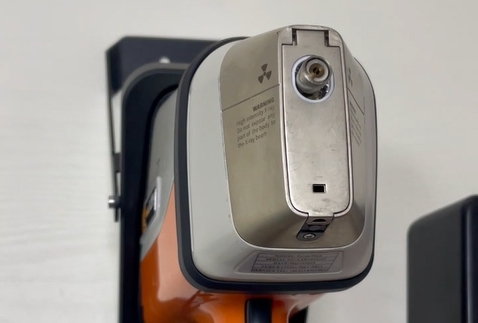
X-ray Fluorescence Spectroscopy (XRF) is a non-destructive analytical technique used for elemental analysis. It is based on the fluorescence radiation emitted by a material when excited by X-rays, and the measurement of the energy and intensity of this fluorescence radiation is used to determine the elemental composition of a sample. The basic principle of XRF analysis is that when a sample is excited by high-energy X-rays, its atoms absorb X-ray energy and, upon absorption, release this energy, producing X-ray fluorescence radiation at specific energy levels. Each element has its unique X-ray energy levels, so measuring the energy and intensity of these fluorescence radiations can be used to determine which elements are present in a sample and their relative abundance. XRF finds wide application in geology, mining, environmental science, materials science, pharmaceuticals, metallurgy, the food industry, and many other fields. Handheld elemental analyzers are one of the primary detection tools based on XRF.
So, how do you choose the most suitable portable XRF instrument for your needs? Selecting the right portable XRF instrument involves considering multiple factors, including the application area, range of elements, performance requirements, sample types, portability, analysis speed, data processing and software, budget, support and training, safety standards, user feedback, and upgradability, among others. Based on these criteria, it is highly recommended to consider the various series of handheld analyzers from the AXR brand. This brand offers a wide range of applications, nearly covering all the application areas mentioned earlier. It can detect a range of elements, including Ti, V, Cr, Mn, Fe, Co, Ni, Hf, Ta, Re, Cu, Zn, W, Se, Pb, Bi, Zr, Nb, Mo, Al, Pd, Ag, Sn, Sb, and more, depending on the mode. The detectors used are High-performance Si-Pin detectors or Optimized SDD detectors. These instruments are suitable for a wide variety of sample types, are compact and lightweight, highly portable, provide fast analysis (typically 15 to 30 seconds per test), have reasonable software update frequencies, offer excellent value for money, and provide product training and regular updates. User feedback rates are above 95%, making it one of the most popular brands in its category.
Selecting the right portable metal analyzer for your on-the-go testing needs is a crucial decision. To make an informed choice, carefully evaluate your analytical requirements, consider the analytical technique, and take into account factors like portability, battery life, durability, user interface, calibration, and budget. By doing so, you can ensure that your investment will serve you well and contribute to the success of your analytical tasks, whether in mining, metallurgy, environmental monitoring, or quality control.
 Your location:
