

In today's fast-paced modern society, the continuous advancement of technology has brought unprecedented convenience and efficiency to various industries. In the field of material analysis, the emergence of portable XRF metal analyzers is like a bright light, injecting new vitality into on-site analysis. Whether in archaeological exploration or quality assurance in industrial production, these instruments have become a powerful assistant for industry professionals due to their fast, accurate and portable characteristics. Let’s explore how portable XRF metal analyzers have improved the level of on-site analysis and their role in various industries.
X-ray fluorescence (XRF) is a non-destructive analytical technique used to determine the elemental composition of materials. It works by irradiating a sample with high-energy X-rays, which causes the atoms within the sample to emit characteristic fluorescent X-rays. By measuring the energy and intensity of these emitted X-rays, XRF analyzers can identify and quantify the elements present in the sample.
Traditionally, metal analysis required samples to be collected and transported to a laboratory for analysis, a process that could be time-consuming and costly. However, with the advent of portable XRF analyzers, this paradigm has shifted dramatically. These handheld devices allow for real-time, on-site analysis, eliminating the need for sample collection and transportation.

XRF portable metal analyzers have a wide range of applications across industries, with three key areas including:
1. Mining: In the mining industry, XRF portable metal analyzers are an indispensable tool. Miners can use this portable device to quickly analyze collected core samples to determine the composition and grade of ore. This is critical for ore exploration, quality control and mining decisions. With instant access to analytical data, mining companies can effectively guide mining operations, improve production efficiency, and ensure maximum optimization of resource utilization.
2. Manufacturing :In manufacturing, XRF portable metal analyzers play a key role, especially in quality control and material verification. Manufacturers can use this equipment to conduct instant analysis of metal parts in production to ensure that their alloy composition meets design requirements and standards. This helps prevent manufacturing defects and product quality issues, improves product reliability, and ensures the final product meets customer expectations and requirements.
3. Environmental Science :In the field of environmental science, XRF portable metal analyzers are widely used for pollution monitoring of soil and water bodies and analysis of environmental samples. Researchers and environmental protection agencies can use this equipment to quickly measure the content of heavy metals in environmental samples to assess the health of soil and water bodies, monitor pollution sources, and develop corresponding environmental protection and remediation measures. Its fast, accurate and non-destructive characteristics make XRF portable metal analyzers an important tool in environmental monitoring and protection work, helping to protect and maintain the health and balance of natural ecosystems.
XRF portable metal analyzers offer numerous advantages, including:
1. Real-time analysis :XRF portable metal analyzers enable rapid, real-time analysis in the field without the need to send samples to a laboratory. This instant analysis capability allows users to immediately obtain sample composition information, allowing rapid decision-making. In the mining field, for example, miners can immediately determine the composition of ore at the exploration site to guide subsequent mining work; in manufacturing, engineers on the production line can instantly check the quality of product materials to ensure that the product meets standards.
2. Portability :XRF portable metal analyzers are usually designed to be lightweight and portable, making them easy to carry to different field work locations. This enables users to perform analyzes outside the laboratory, even in remote or harsh working environments. For example, archaeologists can take this instrument to field archaeological sites to conduct on-site analysis of artifacts without having to bring samples back to the laboratory.
3. Non-destructive analysis :The XRF portable metal analyzer uses a non-destructive analysis method, that is, the sample will not be damaged during the analysis process. This means users can perform analyzes while maintaining sample integrity without fear of damage to the sample. This feature is particularly important in the fields of archeology and heritage conservation, where destructive analyzes can damage precious artifact samples.
In the mining sector, timely and accurate determination of the composition and grade of ore is crucial for deciding mining areas, optimizing production processes and ensuring product quality. Traditionally, this type of analysis requires sending samples to a laboratory, which is time-consuming and not conducive to immediate decision-making. However, with the development of portable XRF metal analyzers, mining companies can perform analysis quickly and accurately on site, thus greatly improving the level of mining on-site analysis.
When a mining company conducts ore exploration, it often needs to quickly and accurately analyze core samples to determine the composition and grade of the ore and formulate a mining plan accordingly. In the past, they often needed to send collected core samples to a laboratory for chemical analysis, which was often time-consuming and labor-intensive and could lead to delays in decision-making. To solve this problem, the company decided to use a portable XRF metal analyzer for on-site analysis.
After collecting the core samples, miners immediately analyze the samples using portable XRF metal analyzers.
Using the XRF instrument's software interface, the miner enters basic information about the sample and points the instrument at the sample surface.
The instrument quickly determines the content of each element in the sample by emitting X-rays and measuring the characteristic X-rays emitted by the sample.
Analysis results are displayed immediately on the instrument screen, including the percentage of each element and the overall grade.
Based on the analysis results, miners can instantly adjust the direction of exploration, determine the scope of the ore body, or formulate a mining strategy.
Improve production efficiency: The use of portable XRF metal analyzers greatly reduces the time to analyze samples, allowing miners to make decisions quickly and improve the efficiency of exploration.
Reduced costs: It is no longer necessary to send samples to the laboratory for analysis, saving transportation and laboratory expenses and reducing exploration costs.
Accurate decision-making: Real-time analysis results allow mining companies to more accurately assess the grade and composition of ore bodies, thereby making more targeted mining decisions and optimizing resource utilization to the greatest extent.
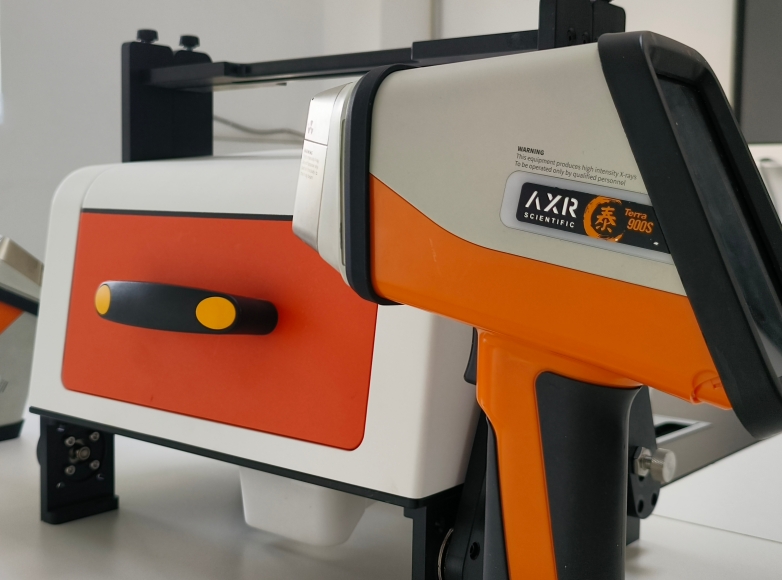
The Terra 900 series handheld alloy analyzer is an ideal tool for metal analysis in multiple fields such as quality control, grade identification, material classification, and safety precautions. Based on advanced electronic technology and unique software algorithms. The Terra 900 Series completes metal composition analysis in seconds and displays the alloy grade and elemental content on the touch screen. Users can operate the instrument proficiently with only simple training. Sample detection is not limited by location, sample shape and size, and does not require sample preparation. The excitation source is a ceramic packaged microfocus X-ray tube, and the silver target is 50KV; the detector uses a high-performance Si-Pin detector/SDD detector (graphene window); the resolution is up to 140eV FWHM/129eV FWHM; kapton window, Optional carbon fiber anti-puncture window; the CPU is i.MX 8M Mini quad-core 1.8GHz, the multi-channel processor is a 4096-pixel multi-channel analyzer/80 MHz ADC digital signal processor, and the unique AXRUNI mechanism design effectively increases light Tube heat dissipation, Safety Guard induction setting, the light tube automatically shuts down when there is no sample, providing maximum safety protection, and can analyze Ti, V, Cr, Mn, Fe, Co, Ni, Hf, Ta, Re, Cu, Zn, W, Se, Pb, Bi, Zr, Nb, Mo, Al, Pd, Ag, Sn, Sb, etc.
XRF portable metal analyzers have revolutionized field analysis, providing researchers and professionals across various industries with a powerful tool for elemental analysis. Their portability, speed, and accuracy make them indispensable for on-site testing and real-time decision-making. From ancient archaeological sites to modern industrial production lines, portable XRF metal analyzers have always played an irreplaceable role in different fields. Their portability, real-time and accuracy provide unprecedented convenience for on-site analysis, promote the progress of scientific research, promote the development of industrial production, and protect the health of the environment. With the continuous innovation of science and technology, we are confident that portable XRF metal analyzers will continue to play an important role and contribute to the development and progress of mankind.
 Your location:
