

In the ever-evolving world of material science and industrial applications, precision is the name of the game. Accurate analysis of metal composition is crucial for industries ranging from manufacturing to mining, ensuring product quality, safety, and compliance with regulations. Traditionally, metal analysis has been a time-consuming and costly process, involving complex equipment and specialized laboratories. However, the emergence of handheld spectrometer for metal analysis has revolutionized the way we approach metal analysis, putting precision in the palm of your hand.
In the past, the analysis of metal composition often requSired extensive sample preparation and laboratory-based instruments such as atomic absorption spectrometers, inductively coupled plasma spectrometers, or X-ray fluorescence analyzers. While these methods provided highly accurate results, they were not without their drawbacks. They were expensive, cumbersome, and required trained operators to perform the analysis. Additionally, transporting samples from the field to the lab for testing could lead to delays in decision-making and increased costs.
Handheld spectrometers have emerged as a groundbreaking solution to these challenges. These portable devices, which are typically about the size of a smartphone, leverage the principles of spectroscopy to identify and quantify the elemental composition of materials rapidly and with remarkable accuracy. They use various techniques, such as X-ray fluorescence (XRF) and laser-induced breakdown spectroscopy (LIBS), to analyze samples on-site, making them particularly valuable for industries that demand real-time results.
Portability: Handheld spectrometers are compact and lightweight, making them easy to carry to the field or point of analysis.
Real-time Analysis: Results are generated within seconds, allowing for immediate decision-making, reducing downtime, and improving productivity.
Non-destructive: Handheld spectrometers require minimal sample preparation, and the analysis is non-destructive, preserving the integrity of the material being tested.
Cost-Efficiency: They eliminate the need for expensive laboratory testing and the associated costs of sample transportation.
User-Friendly: These devices are designed for ease of use and can be operated by non-specialists with minimal training.
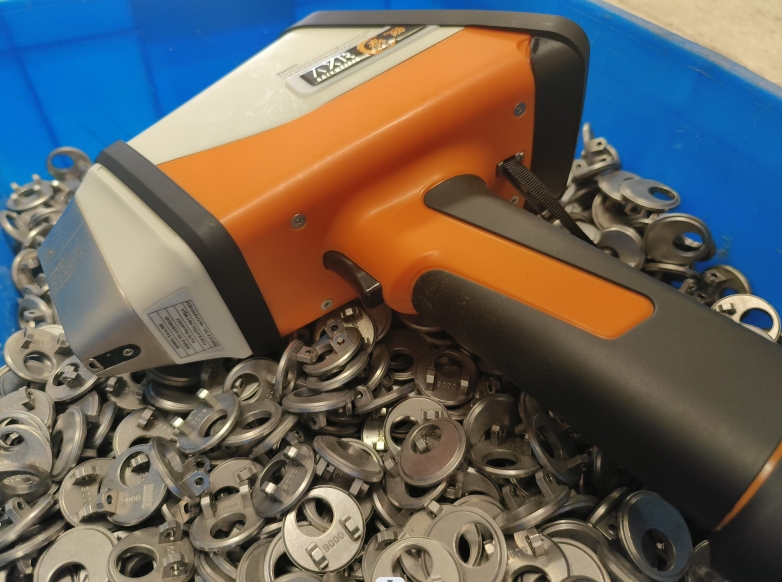
Among numerous handheld alloy analyzer products, AXR Terra900 series are good choice for metal analysis in many fileds, delivering rapid, accurate results right in your hand. Due to the advanced electronics and state-of-the-art mathematical algorithms, Terra900 series provide ultimate quality of measurement within a couple of seconds, which makes it the ideal solution for checking and analyzing incoming material, finished goods and in process production pars with a non destructive way. With operating simplicity, you can view the alloy grade and chemistry on the touch screen display with just a few seconds to obtain lab-quality chemistry, requiring minimal training and little or no sample preparation for all shape and size of sample.
Handheld spectrometers have found applications in diverse industries, including:
Metallurgy: Rapid analysis of metal alloys for quality control in manufacturing and metallurgical processes.
Mining: On-site exploration and ore analysis to identify valuable minerals and optimize extraction processes.
Environmental Monitoring: Detection of hazardous materials and pollutants, aiding in environmental protection efforts.
Art Authentication: Identifying the composition of art and cultural heritage materials, aiding in authentication and restoration.
Pharmaceuticals: Verification of raw materials in the pharmaceutical industry to ensure quality and safety.
Agriculture: Determining nutrient levels in soils for precision agriculture.
While handheld spectrometers offer numerous advantages, they are not without limitations. The accuracy of the analysis can be affected by factors such as sample homogeneity, surface condition, and the presence of coatings or contaminants. Additionally, the initial investment cost of these devices can be significant, and routine calibration and maintenance are required to ensure accurate results.
As technology continues to advance, handheld spectrometers are likely to become even more powerful and versatile. Integration with data analysis software and connectivity to cloud services may further streamline the analysis process and provide valuable insights for industries. Researchers are continually working to improve the precision and sensitivity of these devices, making them more reliable for a wider range of applications.
In conclusion, handheld spectrometers have brought precision in metal analysis to the palm of our hands, transforming industries that rely on accurate elemental composition data. These portable devices offer real-time results, cost-efficiency, and ease of use, making them a valuable tool for various sectors. As technology advances, we can expect even more capabilities from handheld spectrometers, expanding their applications and ensuring they remain at the forefront of metal analysis in the years to come.
 Your location:
